Living Your Best Life, Your Way
Introduction: A Choice for Independent Living Later in Life

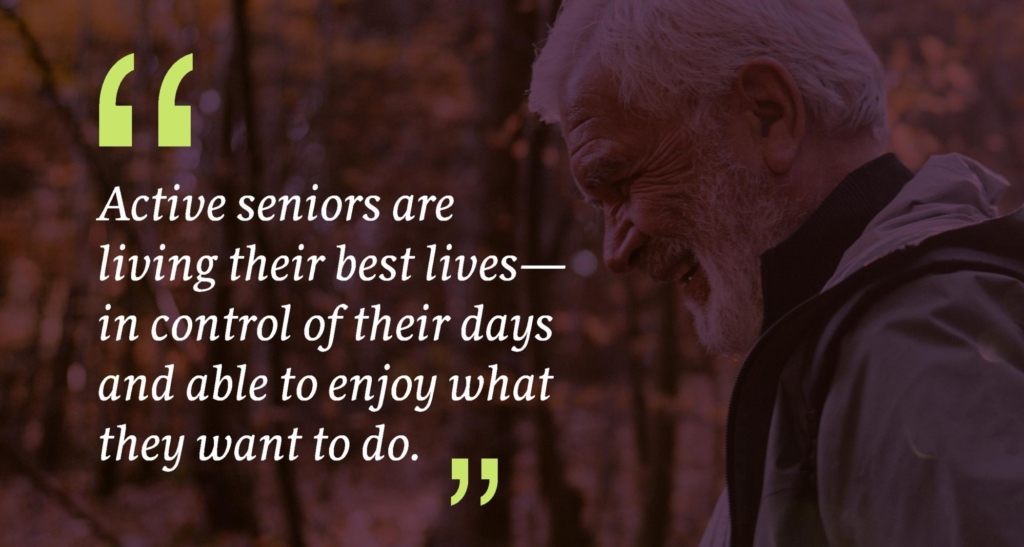
Almost every day on social media or the news, you hear about an energetic eighty-year-old who’s hiking five miles a day or juggling volunteer responsibilities with travel, yoga classes, and visits with grandchildren. These active seniors are living their best lives—in control of their days and able to enjoy what they want to do. They are ideal examples of what defines “aging in place:” seniors staying in their own homes as they get older and bringing in the support needed to continue to live independently.
These stories aren’t unusual in 2025. Canadians are living longer—life expectancy in our country is on the rise, thanks in part to advances in healthcare and, in general, improved living standards. “Super Seniors” are living examples of these factors in action. You don’t have to be running marathons, but with a longer life comes more time to spend with loved ones, travel, and go on adventures. Best of all, aging in place is an especially attractive option because it allows you to enjoy the comfort and familiarity of your own home and community as you grow older.
Living longer, however, comes with its challenges, among them, how to ensure that you live well through these years so that you can age in place. More than a slogan, living well means:
- Maintaining optimal health to the degree that you can,
- Having enough money to live your later years as you see fit, and
- Maintaining control over the healthcare that you may need: its quantity, quality, and by whom it is administered.
Sound good? Let’s see how to turn this slogan into a possibility.
Your Way, Your Choices
Living your best life, your way, means something different for everyone. The choices you need to make will be different as well. They depend on many factors, most importantly, your health and your financial situation.

Options for later in life generally fall into the following broad buckets:
- Retirement Home
- Nursing Home
- Palliative Care
- Your Home: In other words, aging in place
The fourth option—aging in place—is the focus of this whitepaper series. Anecdotally, this is the preferred option for most of our clients. We also know that every Canadian 65 years and older would like to live independently in their own homes for as long as possible.1 So, what’s getting in the way of this option?
While aging in place may be the most popular lifestyle choice for older Canadians, achieving this goal needs to be researched well and a plan must be put in place for how to make it happen. There are emotional, financial, and accessibility decisions to address in addition to ongoing life responsibilities, such as taking care of your health, maintaining up-to-date records and legal documents, and ensuring you are living well and enjoying yourself along the way.
The above may sound overwhelming, given all that is needed to put a plan in place. And Google makes it very easy to get bogged down with too much information and advice. So we’ve broken the process down into bite-sized steps, with defined actions, for creating your aging in place plan:
- Part I covers the top five considerations to consider before you even start making up your mind. Once you’ve understood these key aspects to aging in place, you’re ready to move forward.
- Part II introduces the decision-making process, including how to choose the appropriate substitute decision-makers.
- Part III puts your best life into action. Here’s where we cover how to set up separate smaller plans for the following: your home, finances, future care, and the legacy you want to leave behind, including the people and charitable causes you want to support.
Suggestions for How to Use This Series
Here are some further tips for reading and reflecting on each section in our series:
- Something you read might catch your interest, and you want to do some of your own research. At the end of each paper, we’ve listed resources you can add to your own notes.
- You might want to create a personal journal so you can write your thoughts as you read. Perhaps something causes you to reflect on a memory, or you learn something you want to keep in mind for the future.
- Once you’re done, go for a walk. Seriously! These are important topics, and they take time to process. Neuroscientists tell us that walking unlocks our thinking powers and can calm anxieties—in addition to being good exercise.2
Your Best Life Starts Now
A 2025 report on “The Issue of Aging,” by Western University’s Centre for Activity and Aging, has inspiring words to keep in mind:

You’re about to enter—or may already be in—what many say is the most rewarding and freeing time of your life. We hope that you’re excited about moving forward, and you enjoy the materials we’ve prepared. Write us back. Tell us what you are wondering about. These short papers are meant to kickstart the planning process, but it’s tough to move forward if you’ve got a question on your mind.
1 “Almost 100 per cent of Older Canadians Surveyed Plan to Live Independently in their Own Homes, But Is This Even Possible?” National Institute on Aging, October 13, 2020.
2 “It’s a superpower’: how walking makes us healthier, happier and brainier,” from In Praise of Walking by Shane O’Mara, Vintage, 2020 as excerpted in The Guardian.
3 “Aging is not a Disease,” Western Alumni Magazine, Report on Aging, Spring/Summer 2025.
Part I: Five Considerations for Aging in Place

How do you define “living your best life”? You might want to write down a few words and post them where you can see them while you gather your thoughts.

These notes will help you as you take the first step. There are realities about getting older that sometimes make us forget all those great plans we have for the next stage of our lives.
Keep these reflections handy as you explore this part of our series on key considerations for planning to age in place. Some deal with practicalities, but others are psychological considerations. Acknowledging them (and answering them if you can) is important because you won’t be guessing or assuming any longer—you’ll know what you need to be thinking about.
Five Realities for Consideration
1: Be ready and open to talk about aging
Many have a head-in-the-sand mentality about aging. We just don’t want to talk about getting older! As a result, seniors are not talking about key aging issues with their families. This is no one’s fault. Information about aging issues, effective family communication, costs of long-term health care, and when and how to plan for our later years doesn’t come in any kind of one-stop shop format. While there is a wealth of information available, there is a lack of understanding about what you need to know to make smart, proactive decisions.
Give yourself time to reflect. You also might want to talk further with someone close to you, perhaps going over these questions together.
Ask yourself:
- What am I most looking forward to in my later years?
- What, if any, are my own personal concerns about aging?
- Who will be a part of my support system as I age? What type of support am I expecting from them?
This introspection is important work and will likely uncover key aspects about your wishes for how you’d like to thrive in your later years. The Government of Canada has produced a helpful resource called “Thinking about your future? Plan now to Age in Place” to assist with your self-reflection stage. The document asks questions, allows for reflection, and can help you figure out what you can do now to make aging in place possible on your own terms.
2: Know the Costs
Most underestimate the cost and challenges associated with living at home the rest of their lives. Costs are a practical reality to be reviewed and updated as needed.
- Home, or community care: Home, or community care offers limited subsidies or care coverage. Privately paid caregivers are often necessary to supplement any subsidized care that may be available. Personal support workers will come into your home to help with things like light housekeeping or meal preparation. This could represent costs anywhere between $1,000 to $3,500 per month or more.1
- Private nursing: On the higher end of the cost spectrum, hiring a private nurse to come to your home can reach up to $80 per hour, or upwards of $100,000 a year.2
- 24-hour Care: Should you require 24-hour care in your home, this could cost upwards of $25,000 a month or $300,000+ a year.3
3: Timing
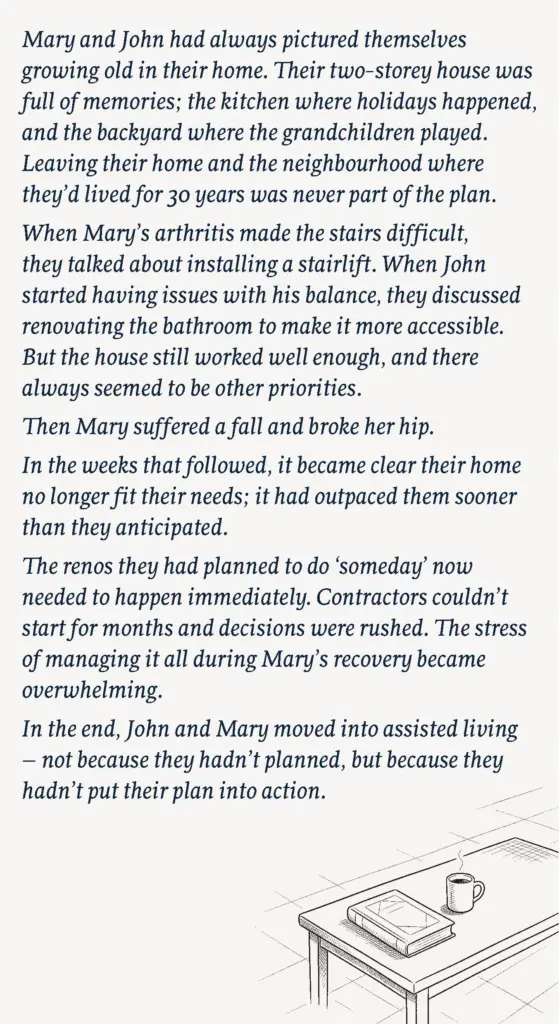 While aging in place may be the goal, for some, it can eventually become untenable to remain in their home. As we get older, our mobility decreases. Special accessibility features may be required to ensure safety when using stairs or navigating the bathroom and kitchen. Waiting too long to move or make the necessary changes to one’s surroundings can derail plans to stay in the home.
Timing is also a psychological factor. This is why the first reality, “Be Ready and Open to Talk About Aging,” is so important. Once you’re ready for the next stage of your life, you are more likely to act on the practical matters of aging.
The following example highlights what can unfold when plans are set but not acted on: mounting changes to the home – and the people living in it – become overwhelming, decisions are rushed, and an unintended sale ultimately becomes necessary.
4: Capacity
Your mental capacity may change or decline as you age. If you become incapable of making decisions about your living arrangements on your own, it’s critical that you have a legally appointed substitute decision-maker who can make these decisions in your place (discussed in greater detail below). Your substitute decision-maker needs at least two things: knowledge of your wishes and access to the financial resources to make those wishes a reality.
If you have no legally appointed substitute decision-maker, your loved ones will likely need to obtain advice from an estate planning and guardianship lawyer about the options available to give someone the authority to make decisions on your behalf (more on this later).
5: Your Team
Who’s in your trusted circle? Who are those people you can count on for guidance and support? You don’t need to bring everyone in at once, but here are a few key roles to consider. When it comes to hiring professionals, take your time to find the right fit. Ask your current advisors, friends or family for recommendations, and only work with those people who treat you with respect, put your best interests first, and truly understand what matters to you.
- A trusted friend, sibling, relative: You may have one or many of these. Consider keeping at least one of them in the loop for emotional support and practical help as you move through this process.
- An estate lawyer: For legal advice and support in choosing a substitute decision-maker, drafting essential documents such as Powers of Attorney for property and personal care and updating your will.
- A wealth planner: To work together with you to create a sustainable financial plan to support your aging-in-place goals.
- A Certified Aging in Place Specialist (CAPS): They can act as a guide to help you make informed decisions about adapting your home if necessary. You can find more information about home assessments and modifications in the Resource section.
- Anyone else? If you feel you need support in a different part of this process, there’s likely a specialist or consultant who can help. We’ve worked with many different types of professionals in this area and would be happy to make a recommendation.
Take a Deep Breath
You’ve just reviewed the five critical issues you need to consider before deciding about aging in place. As lovable Bill Nye the Science Guy always liked to say, “And now you know.”
We hope that living your best life—your way—still appeals to you and you are ready to take the next step. Take a moment to return to the notes you wrote about what you’d like to do in the next 5, 10, 15 years. Maybe you want to add to the list!
1 National Institute on Ageing (NIA), Ageing in the Right Place: Supporting Older Canadians to Live Where They Want.
2 Sun Life, Long-Term Care in Ontario.
3 National Institute on Ageing (NIA), Ageing in the Right Place: Supporting Older Canadians to Live Where They Want.
Part II: Communicating Your Decision to Age in Place

At the beginning of this series on Aging in Place, we talked about how everyone defines their “best life” differently. If your best life means living in your own home independently, make sure you’ve reviewed the five critical considerations in Part One so you are ready to put the next pieces in place. These included two important steps:
- Choosing substitute decision-makers, with documents completed. This covers off the question, “What happens if my mental capacity becomes an issue?”
- Having conversations with your substitute decision-maker(s), family, and close friends.

Enlist Your Substitute Decision-makers
Covering the bases starts with acknowledging that if a time comes when you are unable to make decisions for yourself, you’re prepared with legally appointed and properly informed individuals to act on your behalf.
Choosing the right person for this role requires careful consideration. You can legally appoint substitute decision-makers through two key documents:
- A continuing power of attorney for property, which allows someone you name to manage your finances and matters related to your property on your behalf.
- A power of attorney for personal care, which allows you to name someone you want to make decisions related to your personal care, including healthcare, nutrition, clothing, shelter, hygiene, and safety.
You might name the same or different people for these roles. You might also choose more than one person for one or both roles.
Some factors to think about when considering whom to appoint as your substitute decision-maker include:
- Who in your life do you trust to fulfill your wishes to the best of their ability?
- Who in your life is willing and able to act in these roles, understanding that they are taking on a significant responsibility?
- If you are considering appointing different substitute decision-makers for property and personal care, can these individuals work well together to coordinate the management of your affairs?
- Who do you want to name as alternate decision-makers if your first choices are not able to make decisions for you?
Communicate with Your Loved Ones
 Now it’s time to move to the most important aspect of this exercise: sharing your wishes with your loved ones. Return to the “Take time to reflect” questions in Part One. Your answers may make it easier to discuss your plans with loved ones who are likely to have similar questions. This is also the time when you assure your family that your documents are now in place.
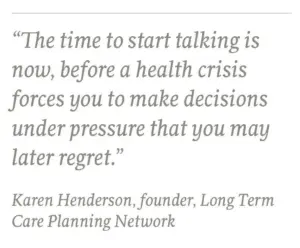
Aging specialist, Karen Henderson, developed the Care Conversation to begin the dialogue with family about aging issues that impact all of us. The resource suggests questions to ask yourself (yes, more introspection!) and includes information about legal preparation, logistics around planning a family meeting, and of course, financial organization (which we are always happy to discuss, as wealth planners!).
It is especially important to discuss any wishes you have that your loved ones may find surprising or unexpected. Include the people you plan to appoint as your substitute decision-makers. Clear, open communication ensures your loved ones can fulfill your wishes. For instance, do your kids know that you’ve always planned to return to your roots on the East Coast when you sell the family home? Or that you don’t want to move in with them when you can’t manage on your own? These open conversations go a long way to prevent future conflict around your wishes and decision making.
Push Back Against Agism
Here’s a tip. Keep in mind there is what experts call an “unconscious bias” about aging that assumes that just because you are older, you no longer can live independently.
As you talk about your wishes, be confident in the choices you are making.
Some Homework
In the next paper, we’ll talk about the financial factors to consider when making your plan. In preparation, you might want to review those notes you’ve written down and remind yourself about living your best life and what that means to you. Here is where a Value/Cost list for your best life might be helpful. Simply create a two-column chart, one for “value” and one for “cost” (money, time, space, etc.)
For example, if health is a value, what do you need in the years ahead to support your health? For some, this may mean the cost of a fitness club. For others, there is no cost if they can go for a walk each day in their neighbourhood. If family is a value, and your family lives far away, traveling to visit grandchildren will be an expense.
Below is an example of how a Value/Cost list might look. We’ve left some room here for you to write down some of your own:
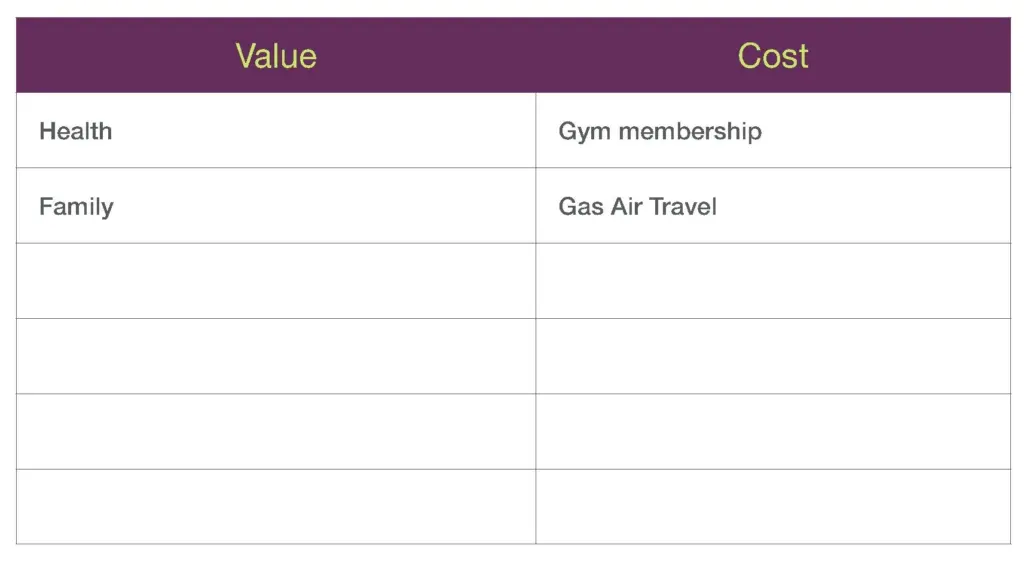
This simple exercise will help clarify what truly matters to you and what it might take to support those priorities, setting the stage for the next part of your planning: building a wealth plan that supports the life you want to live.
Part III: The Financial Side of Aging in Place

Does this sound familiar?
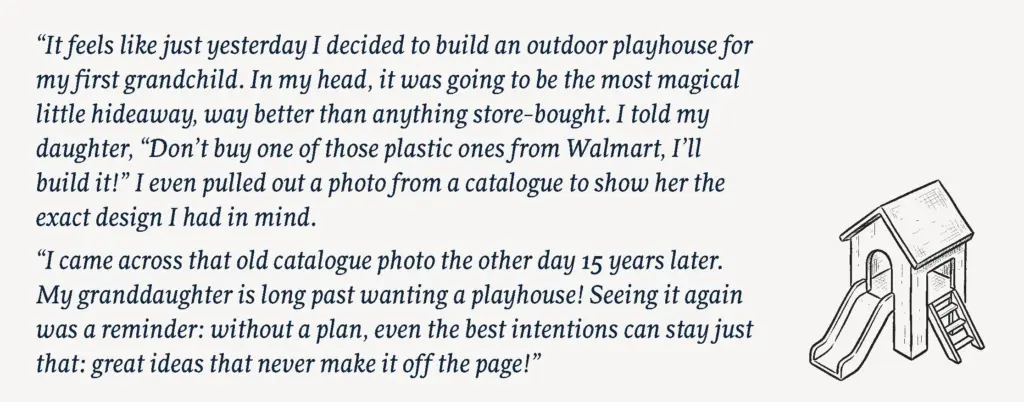
There is no substitute for a good plan if you want to make aging in place a reality.
As we covered in Part II, your plan should include a conversation with your loved ones and an estate lawyer who can draft the necessary legal documents (powers of attorney, etc.) to appoint your substitute decision-makers and offer practical advice about how you can prepare them for these roles.
Planning should also include a conversation with—you guessed it—your wealth planner.
Why Your Wealth Planner Asks All Those Questions
Remember the Values/Cost exercise we talked about last time? Your answers will help guide the conversation around the exciting aspects of living your best life, your way.
Aging often brings changes, not just in health but in how we think about the future. That’s why it’s so important to share information with your wealth planner, including family medical history, health concerns, or even general worries about aging. The more we understand your evolving circumstances, the better we can support you. For example, if you’re concerned about mobility down the road, we might explore strategies for downsizing or renovating your home. Continuous and open communication allows us to keep your wealth plan current and ensures your financial strategy continues to reflect your needs over time.
Let’s look at some wealth planning scenarios that attempt to tackle the potentially higher costs of care later in life.
Your Wealth Plan: Incorporating the Costs of Living Longer
 When evaluating the financial impact of aging in place, a wealth plan can help to answer the critical question: “Can I afford to stay home?”
Planning for the future can be surprisingly challenging. We’re forced to make decisions with incomplete information, whether addressing a specific issue or a general “what if” scenario. Essentially, none of us can predict the future, and this reality complicates long-term planning.
Let’s begin with a quick overview of how a wealth plan typically comes together. At its core, a wealth plan is built by understanding where you are today—and making thoughtful assumptions about where you’re headed.
- Net worth is your starting point: what you own (especially your retirement savings) minus what you owe (like a mortgage or other debts).
- Estimated spending comes next. How much do you expect to spend, and how might that change over time? We look at your current expenses, then factor in future goals or needs like travel, home renovations or potential care costs.
- Retirement income is about how you’ll cover those expenses. This usually includes a combination of sources like government benefits, workplace pensions, and investment income.
Using this information, we’ll help you understand:
- If your retirement income and savings can comfortably cover your living expenses.
- How long your money might last.
- Whether you’ll have a surplus or an inheritance to consider.
Planning to age in place requires more than just saving enough for day-to-day retirement living—it requires foresight of the unpredictable costs of future healthcare. Yet many people find themselves “guessing” when it comes to these potential expenses. Below are a few examples highlighting how a wealth planner might work with these uncertainties.
I. The Sustainable Wealth Plan
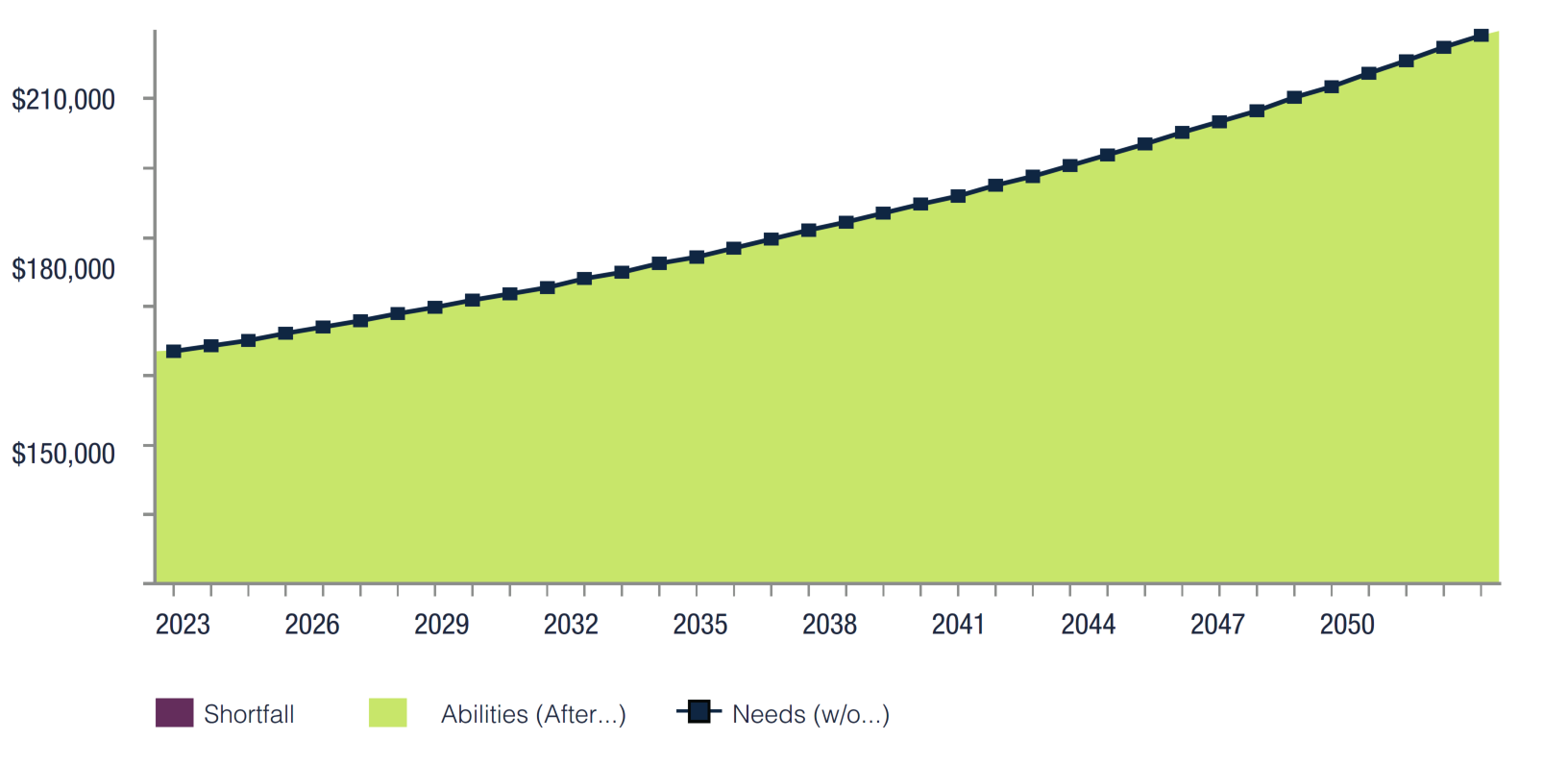
The chart below illustrates a robust retirement plan. The black line represents annual spending, which gradually increases with inflation. The green area shows the retiree’s income, which in this case sufficiently covers rising expenses over time.
At first glance, this appears to be a sustainable plan—retirement income keeps pace with expected costs. But this is only the case if future expenses follow a predictable path.
II. The “What If?” Wealth Plan
Of course, the future rarely follows a predictable path. Asking “what if?” allows us to account for the uncertainties that can disrupt an otherwise sound plan. For instance, “what if” you want to remain in your home as your mobility declines? This question opens the door to a host of considerations, like the potential cost of home accessibility modifications or in-home health care services.
Below, the chart shows a “what if” scenario where in-home health care costs begin at age 85, and over time, needs have become complex. In this case, the retiree’s plan begins to show a deficit, represented by the red area. This indicates that funds are depleted before the end of life.
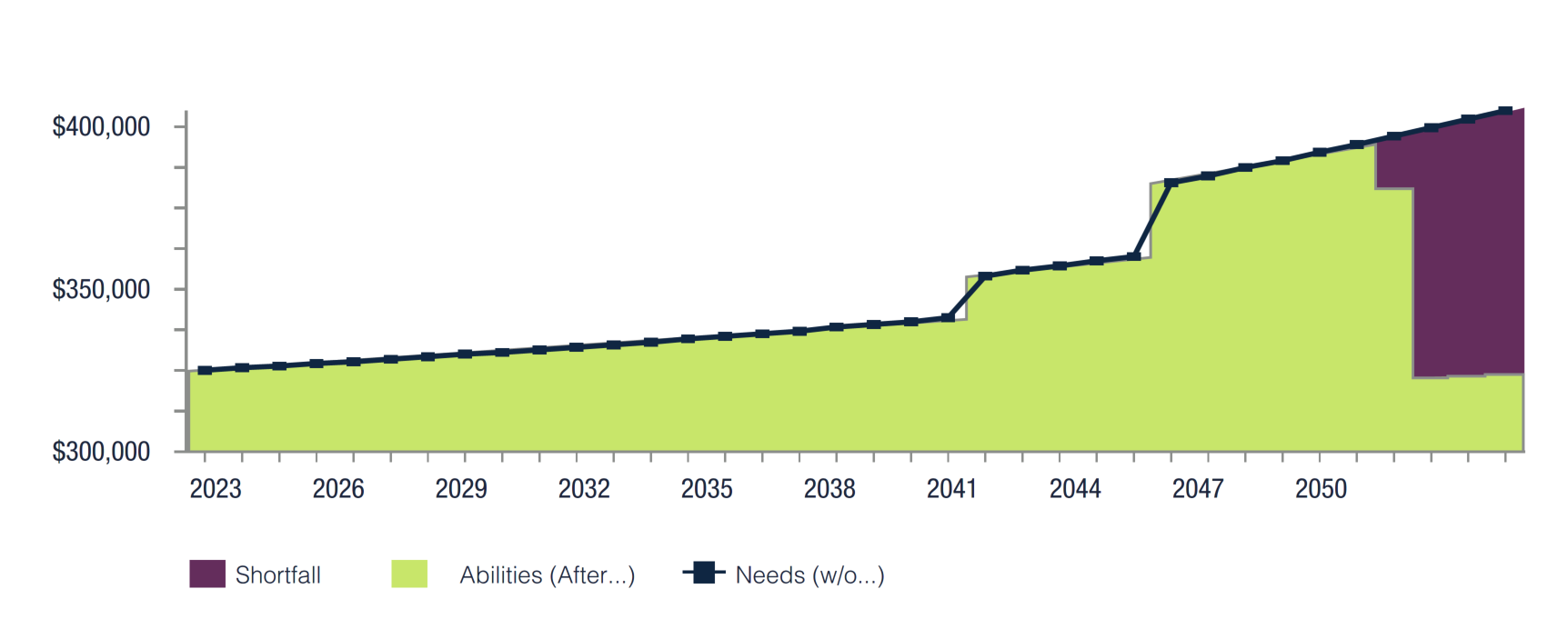
Does this mean that you can’t afford to age at home? Not necessarily.
The “what if” scenario highlights the inherent difficulty with planning when you’re forced to guess about critical future needs. This is especially true given that healthcare costs later in life are notoriously unpredictable. For example:
- Accessibility: Will you need to renovate your home?
- Level of care: If you need care, what level of care will be required?
- Timing: When will healthcare needs begin—and how quickly will they change?
Simple projections fall short because they rely on too many unknowns. To address this, we shift from prediction to preparation. In other words:

Manage Risk Through Flexibility
Even if you’re currently healthy, you can prepare for future care expenses by evaluating your financial ability to manage rising or unexpected costs. A risk-managed plan:
- Uses higher-than-expected estimates for future spending,
- Builds a financial buffer for potential healthcare needs, and
- Treats home equity as a potential safety net if circumstances require tapping into it.
Plan for Alternatives
Flexibility also means identifying your preferences in case aging in place becomes unworkable. This is crucial because costs can vary significantly between options like long-term care, assisted living, or palliative care.
Sharing your wishes with your loved ones and substitute decision-makers can help ensure that, if aging in place is no longer an option, any decisions made will reflect your priorities. So, it’s vital to ask yourself: Where would you feel more comfortable receiving care if your needs were to change?
III. A “Better Informed” Wealth Plan
Our answer to the unknowns of aging is the “Better Informed” wealth plan, one that’s built on dialogue, reflection, and shared understanding. It doesn’t eliminate uncertainty, but it minimizes guesswork by:
- Reflecting your personal values and goals,
- Engaging the people who may be involved in your care, and
- Sharing essential information with your wealth planner.
With more informed assumptions, your plan becomes more actionable and resilient.
Even in this more informed state, you may still not know when or if significant health-related costs will arise. But by planning proactively, you’re far more likely to maintain control and avoid crisis-driven decisions.
It’s Time to Begin: The Next Steps Are Up to You
 As in most areas of our lives, planning ahead offers innumerable benefits. When you create a solid plan for aging in place, you can expect:
- Reduced Stress: For both you and your family. A clear plan gives everyone a sense of control and predictability.
- Preparedness: You’ll identify potential risks beforehand and develop strategies to handle them.
- Empowerment: You’ll make better, more informed decisions because you’re following a well-thought-out roadmap.
- Clarity: Communication improves, making sure everyone involved understands their roles and responsibilities.
- Harmony: You’ll reduce the chance of conflict among your loved ones, as there’ll be no confusion about your wishes.
- Peace of Mind: You’ll feel more confident knowing your wishes for the future are well on their way to being achieved.
That peace of mind and confidence are the foundations for everything that comes next. We hope this series on aging in place has not only informed you but also inspired you to take the first step: beginning the conversation about your wishes today. Taking action early is the greatest gift you can give yourself and those you love. Thoughtful planning and open communication today will give you the freedom to live on your own terms tomorrow.
Resources

Practical Resources
While AI tools can gather and summarize information, rest assured the following resources have been carefully selected by human beings on our team to ensure you have reliable material for your own research.
Aging in Place
- Aging in Place Toolkit: This resource encourages you to think about the various aspects of healthy and independent aging for you and your loved ones.
Talking to Family & Loved Ones
- Care Conversation: A resource from Long Term Care Planning Network to help you start the conversation with your family.
Your Home
- Home safety assessments via Age Safe Canada.
- Maintaining Seniors’ Independence Through Home Adaptations: A Self-Assessment Guide: This guide addresses how many homes aren’t designed for aging, identifying common difficulties seniors face and suggesting adaptations to overcome them.
- Above & Beyond Interiors: A renovation and construction company that focuses on improving functionality and accessibility of homes for seniors who want to age in place.
Your Health
- Ontario Health at Home. Coordinates in-home and community care & support via assessments, in-home health services, referrals and help managing long-term care home placement process.
- Plan Well Guide: Proactive Life Planning to Help You Live Well, Age Well and Die Well
Learning & Inspiration
Here are some of our favorite books, podcasts, and films that share insight, humour, and perspective on the experience of aging.
Books
- “Olive Kitteridge” and “Olive, Again” by Elizabeth Strout: Pulitzer Prize-winning novels that follow a retired schoolteacher in Maine, offering sharp, moving insights into aging, resilience, and community ties.
- “A Man Called Ove” by Fredrik Backman: A heartwarming tale of a grumpy yet lovable man whose life is transformed through community, connection and rediscovering purpose in the comfort of his familiar home.
Podcasts
- “Aging in Place” podcast with Dr. Debi Lynes: This practical podcast addresses aging in place, featuring experts on home design, safety, technology, and resources that support independent living. Available on all podcast platforms.
- “70 Over 70” (archived episodes): This podcast is about how we make the most of the time we have left. Host Max Linsky interviews 70 people over 70, including celebrities and everyday individuals, sharing insights on aging, resilience, and living purposefully in their own homes. Available on all podcast platforms.
Films
- Cocoon (1985): Elderly residents discover alien cocoons that restore youth and vitality. Directed by Ron Howard; stars Brian Dennehy, Hume Cronyn, and Jessica Tandy.
- The Best Exotic Marigold Hotel (2011) & The Second-Best Exotic Marigold Hotel (2015): British retirees move to a dilapidated Indian hotel, finding new adventures and friendships
- The Bucket List (2007):Two terminally ill men create a “bucket list” and embark on a global adventure, finding humor and friendship, starring Jack Nicholson and Morgan Freeman
TV shows
- The Kominsky Method (Netflix, 2018-2021): Aging friends navigate loss, illness, and dating in LA with humor. Stars Michael Douglas, Alan Arkin, and Kathleen Turner.
- Grace and Frankie (Netflix, 2015-2022): Two women reinvent their lives in their 70s, exploring friendship, family, and health with humor. Stars Jane Fonda and Lily Tomlin.
- A Man on the Inside (Netflix, 2025): A retired widower becomes an amateur detective, exploring aging, loneliness, and community. Stars Ted Danson.
TED Talks
- “Older people are happier“ by Laura Carstensen
- “Life’s third act“ by Jane Fonda
About Our Series
Our Living to 100 series brings together expert perspectives and practical insights to help our clients live well today and into the future. With a focus on longevity, financial resilience, and health, our goal is to help clients feel informed, prepared, and confident about the years ahead.
Contacts:
 |
Brad Weber, CPA, CA, CFP, CIMVice President, Head of Wealth Planning |
 |
Kathleen Peace, CFAVice President, Head of Business Development |
 |
Brittany MillerPartner at Goddard & Gamage LLP |
Download the PDF