
Be Careful of “Gamifying” Your Investments
Q2 | April 2026

Topic: Investments
April 29, 2026
Image used with permission: iStock/gorodenkoff
On a Side Note…
See another Investments Nexus Notes Quarterly article that may be of interest to you.
The Most Underrated Investment Tool
Be Careful of “Gamifying” Your Investments
Q2 | April 2026
Are you counting your steps each day? Do you know what your “sleep score” was last night?
Remarkable advancements in technology over the last 15-20 years have made plenty of useful tools and “apps” accessible to the public. These trends are part of a wider shift in society to quantify and “gamify” self-improvement. This shift turns the slow, invisible work of building better habits into something measurable, visible, and rewarding. Seeing your step count climb or your language streak hold motivates real behaviour change. But when this same psychology moves into personal finance, the stakes can change entirely.
Gamification in personal finance isn’t inherently evil. Earning badges for hitting a savings milestone or getting a nudge to automate a transfer can build positive habits for people who otherwise avoid their finances entirely. But there’s a meaningful difference between tools that make good behaviour feel rewarding and tools that make risky behaviour feel exciting.
What makes this particularly concerning is who it reaches. Gamified investing platforms have disproportionately attracted younger, less experienced investors who are forming their financial habits for the first time.
The Leaderboard Problem
A recent example worth examining is the Wealth Rank feature some investment platforms offer. The Wealth Rank shows users a snapshot of their financial ranking based on investible assets compared to other people the same age. On the surface, it sounds informative. In practice, it’s a leaderboard. This is the same psychological mechanic that keeps people glued to video games and social media. When your financial app starts showing you how you stack up against other users, you’re no longer asking “am I on track to meet my goals?” You’re asking, “how do I move up the rankings?” Those are very different questions, and only one of them leads to sound financial decisions.
Leaderboards are deeply misleading as a measure of financial health. A 30-year-old who inherited a windfall will sit atop a Wealth Rank list over a 30-year-old who saved diligently for a decade. Ranking investible assets without context strips away everything that makes financial planning meaningful: income stability, family obligations, time horizon, risk tolerance, and long-term goals.
This means a young investor holding a large fixed income allocation ahead of a planned home purchase is not “losing” to a same-age peer with an all-equity portfolio simply because their returns have lagged during a strong equity run. They are not playing the same game. Measuring success against your own plan, rather than against a stranger’s portfolio, is one of the most important mental shifts any investor can make.
Staying Calm
As Nexus’s Devin Crago explored in Market Noise: How to Beat it with Temperament, investors are constantly bombarded by stimuli: flashing prices, sensational headlines, and alerts that create an irresistible urge to act. Gamified platforms supercharge this tendency. They reward engagement. More trades, more notifications, and more social sharing have a natural incentive to keep users active, regardless of whether the activity is financially beneficial. They lead people to start panic-checking their investments, focusing on daily results over shorter periods of time. This angst to act threatens the self-control, commitment, and emotional fortitude that he argues are crucial to a resilient, long-term investor.
Increased engagement often leads investors to take more risk than they should. That might mean concentrating into a few volatile stocks, trying to time the market, or following trends that are already overheated. There is a short memory for the risks taken and a long memory for the returns earned. And due to market conditions, the absence of recent consequences has become its own kind of twisted endorsement. When everything is going up, bold bets look like genius. Concentration looks like conviction. Speculation looks like strategy.
Understanding Risk
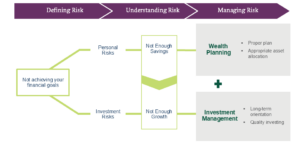
How does this behaviour compare to how Nexus evaluates risk? At the core of Nexus’s risk management process is the belief that, for clients, risk means not achieving their financial goals. There is no leaderboard. We use careful asset allocation, diversification, and a focus on high-quality holdings with reasonable valuation to build in a margin of safety. Everyone has different circumstances and different goals. Our job is to understand those circumstances and create a disciplined plan to achieve the corresponding goals.
The Runner Analogy
Consider two different types of runners. The first is slower and disciplined. They train consistently, rarely get injured, and show up to every race. The second runner is naturally fast. They skip sessions when motivation dips, push too hard when confidence is high, and are inconsistent with their training. What the second type of runner is not prepared for, is spending weeks on the sideline nursing a pulled hamstring they never saw coming.
The analogy maps almost perfectly onto disciplined investing. A high-risk investor might post eye-catching returns in a strong market. They may record impressive results that look great on a leaderboard or a Wealth Rank. But that same investor, chasing the next big trade and swinging for outsized gains, is far more likely to get tripped up by a market correction, a bad bet, or simply the emotional exhaustion of riding a volatile portfolio. The steady investor, by contrast, keeps showing up. Consistent contributions, diversified holdings, and a long-term orientation rarely make for exciting conversation, but they have a remarkable tendency to finish every race.
Conclusion
Our Investment Team has long returned to a simple idea from Peter Bernstein, author of Against the Gods: The Remarkable Story of Risk and one of the 20th century’s most respected investment minds.
‘The trick is not to be the hottest stock-picker, the winningest forecaster, or the developer of the neatest model; such victories are transient. The trick is to survive.’
In an era where investing has never been more gamified, the oldest principles remain the most powerful. Over time, the market will always reward patience over excitement, discipline over thrill. The goal was never to win the game. It was never a game to begin with.