
The Fallacy of No Risk: The Slow Lane Isn’t Always the Safe Lane
Q4 | November 2026

Topic: Investments
November 12, 2026
On a Side Note…
See another Investments Nexus Notes Quarterly article that may be of interest to you.
The Most Underrated Investment Tool
The Fallacy of No Risk: The Slow Lane Isn’t Always the Safe Lane
Q4 | November 2026
Picture a car crawling along the highway at 60 km/h. The driver feels careful: hands locked, no sudden moves, no chances taken. They have eliminated the risks they can control, like speeding or a sudden lane change.
But traffic bunches up behind them, other drivers swerve to get around, and the risk of an accident quietly goes up. The driver believes they’re the safest person on the road, when they may be in the most danger, because of risks they never thought to consider. Investing works the same way. Going slowly feels safe, but it isn’t always.
The Risk That Doesn’t Show Up on Your Statement: Inflation
Holding everything in cash or GICs feels safe because the balance never drops. However, preserving one’s purchasing power over time ought to be the conservative investor’s real priority. Inflation is the great enemy of purchasing power; it’s the quiet killer. Cash may hold its nominal value, but what you can buy with it is less and less over time.
Here is how a typical one-year GIC has compared with inflation since 2019:
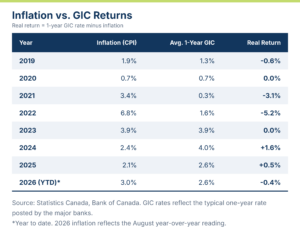
In four of the last eight years, the typical GIC failed to keep up with inflation, and in two it only broke even. The damage in 2021 and 2022 alone cost savers roughly eight percentage points of purchasing power.
To see what that looks like in dollars, consider an investor who put $1,000 into one-year GICs at the start of 2019 and rolled them over each year through the end of 2025. They would have ended up with about $1,152, a compound annual growth rate of roughly 2.0%. Meanwhile, a basket of goods that started at $1,000 and rose with CPI would have cost about $1,231 by the end of 2025, or roughly a 3% increase per year. That’s a gap of nearly $80, which means the investor’s money would buy only about 94 cents on the dollar of what it could in 2019. They earned interest every single year and still fell behind.
Longevity Matters
Canadians are living longer than ever, and that changes the retirement equation. Someone retiring at 65 today may need their portfolio to provide income for 25 to 30 years, and in many cases even longer. Over that time, it’s not enough to simply preserve capital. Your savings must keep up with rising costs for necessities such as groceries, housing, and healthcare. At a 3% inflation rate, the purchasing power of a dollar is reduced by roughly half over a 24-year period.
That math matters even more if retirement is still decades away. If you’re in your thirties, your money may have 30 years to grow before you start drawing on it, and another 25 to 30 years of withdrawals after that. Inflation compounds across that entire stretch, so a portfolio built only to avoid short-term swings can quietly fall behind long before you retire.
This highlights what investors often overlook: the risk of being too conservative. Longevity risk, the possibility of outliving your assets, calls for a balance between stability, income, and growth. The goal is not just to preserve wealth today, but to make sure it keeps supporting your financial needs decades from now. Learn more about the considerations of living longer through our Living to 100 series.
Choosing Where to Take Risk
For investors looking for a conservative approach appropriate for any time horizon other than the very short term, the Nexus North American Income Fund may be a great solution. The fund is built on a foundation of government bonds and high-quality corporate bonds, with an emphasis on shorter-duration bonds. Duration measures how sensitive a bond price is to changes in interest rates, and shorter-duration bonds are less affected than bonds with a longer duration when interest rates move together.
The portfolio’s distinguishing feature is an allocation of up to 20% in dividend-paying equities. Rather than taking additional risk through longer-dated bonds with limited payoffs and no inflation protection, we allocate this modest portion of the portfolio to established, profitable, dividend paying companies. These companies provide income in the form of dividends and also offer the potential for capital growth over time.
Inflation remains one of the greatest long-term risks to investors who rely on income. Many dividend-paying companies can grow their earnings and increase their dividends over time, helping investors maintain purchasing power as the cost of living rises.
In other words, we choose carefully where to take risk rather than pretending it can be eliminated. Most of the Income Fund remains anchored in high-quality bonds, while a limited and deliberate allocation to dividend-paying equities helps generate income, add growth potential, and combat the effects of inflation.
Driving at the Speed of the Road
Good drivers don’t go as fast as possible, and they don’t go as slow as possible. They match the pace of the road ahead. Good investors do the same, matching their portfolio to their goals, their risk tolerance, and how long their money needs to last.